

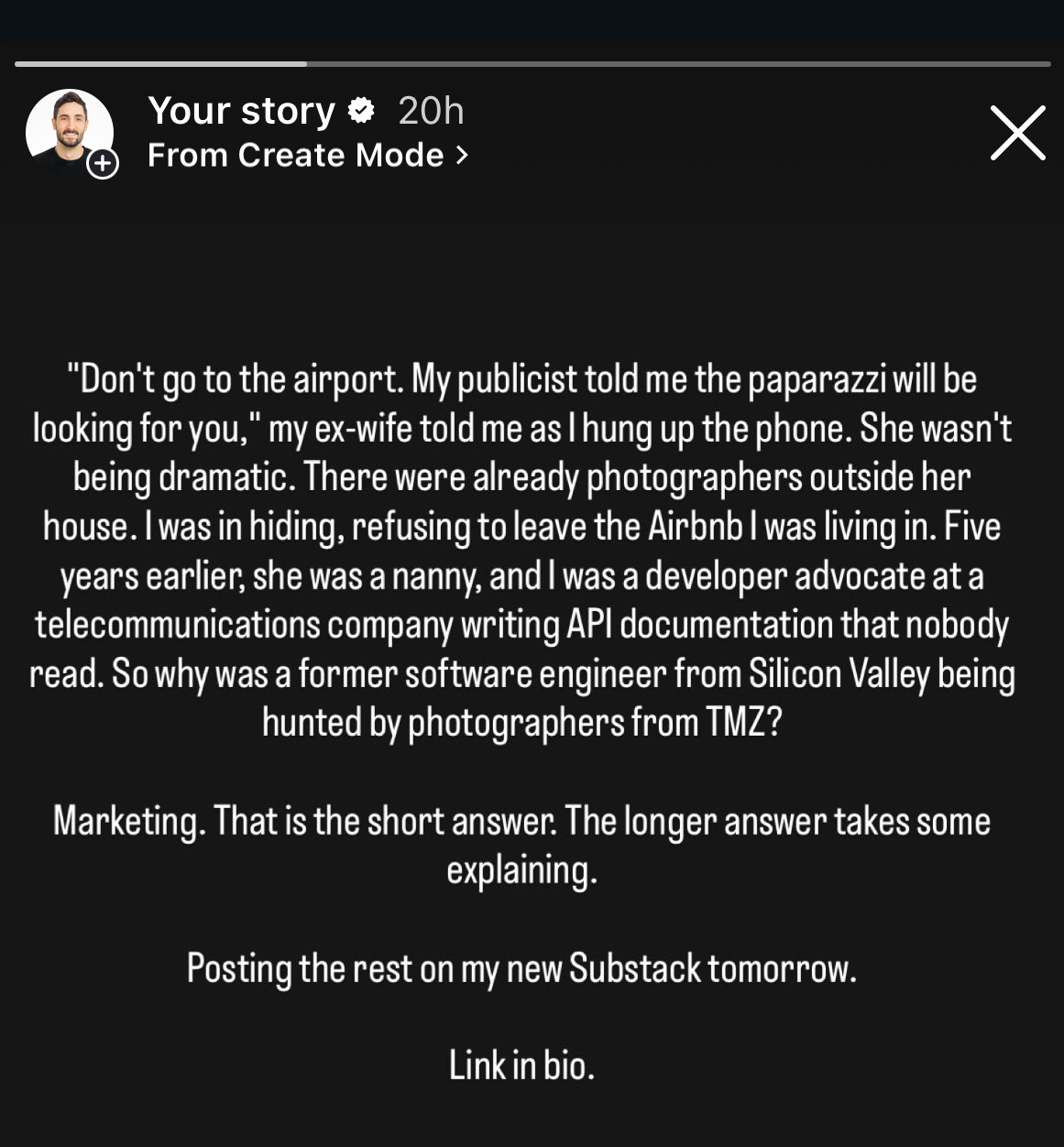
“Don’t go to the airport. My publicist told me the paparazzi will be looking for you,” my ex-wife told me as I hung up the phone. She wasn’t being dramatic. There were already photographers outside her house. I was in hiding, refusing to leave the Airbnb I was living in. Five years earlier, she was a nanny, and I was a developer advocate at a telecommunications company writing API documentation that nobody read. So why was a former software engineer from Silicon Valley being hunted by photographers from TMZ?
Marketing. That is the short answer. The longer answer takes some explaining.
That’s the opening of the book I’m currently writing: The Self-Taught Marketer.
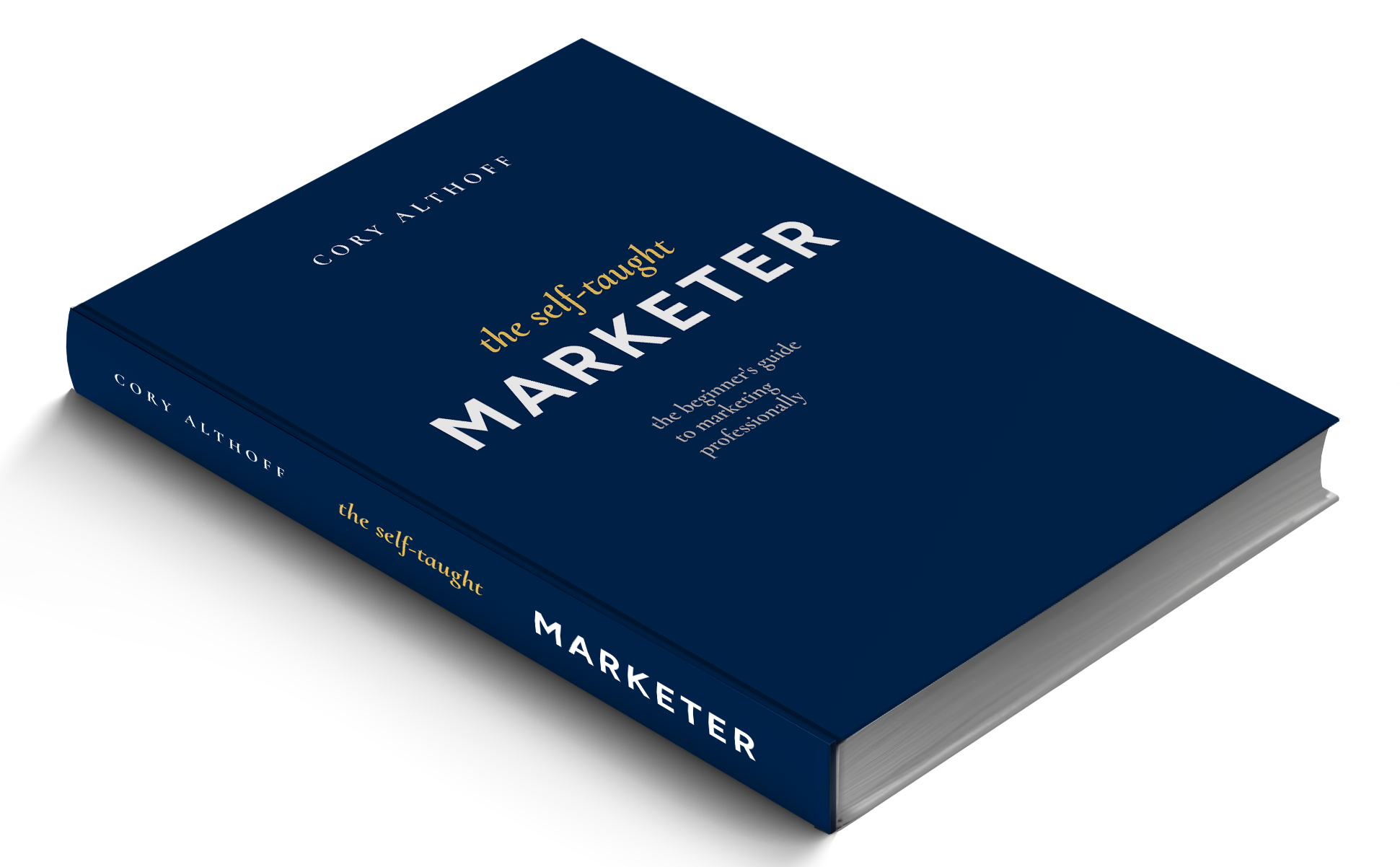
It teaches the lessons I learned marketing my programming books (200K copies sold in eight languages) and helping launch a podcast with more than a billion views.
When I first started writing it, I planned to write it for venture-backed founders. My last two books were about software engineering, and I’m from Silicon Valley, so the startup space seemed like a natural fit.
Before committing to that audience, I talked to potential readers. None of them were venture-backed founders. They were authors, aspiring podcasters, course creators, consultants, app builders, and small business owners. People with something real to sell but without venture money or a marketing team behind them.
If I had written the book for venture-backed founders, it probably would have flopped.
I came so close to violating my own book’s rules and marketing it to an audience without validating that anyone in that audience actually wanted it first.
That’s when I realized it might be interesting to document the experiments behind building an audience and a successful product: talking to customers, testing what works on social media, getting press, finding partners. The things successful products do that nobody ever shows.
That is why I created this Substack. I’m using my book’s own marketing system to launch it in real time. My goal is to sell 200K+ copies and outsell my previous books. And I’m documenting every step so you can see exactly how the methods I teach in it actually work in practice.
My hope is that these experiments help you grow an audience and sell more of whatever you’re building.
My First Experiment
I designed my first experiment to test one thing: how compelling the opening hook of my book is.
Marketing begins with one question: Can you get people to stop scrolling and pay attention? If you can’t, nothing else matters.
The test was simple. Was my hook strong enough to interrupt someone’s attention and get them to subscribe to my Substack?
I posted the following on my Instagram story and X:
The Results
First, some context. I have 42K followers on Instagram. But I rarely post. I think I’ve posted once in the last year. So, I was expecting the algorithm to punish me and not show my story to many people. Furthermore, a lot of the people who follow me do so because of my programming books, not my marketing advice. On x.com, I only have 3K followers and have been even less active on there over the last few years.
With that said, here are the results.
My Instagram story was viewed 7,336 times (with a few hours left to go). My tweet (my X?) was viewed 143 times.
Those two posts took me from 2 Substack subscribers to 57, with one paid subscriber. However, the paid subscriber was my mom. Thanks, Mom!
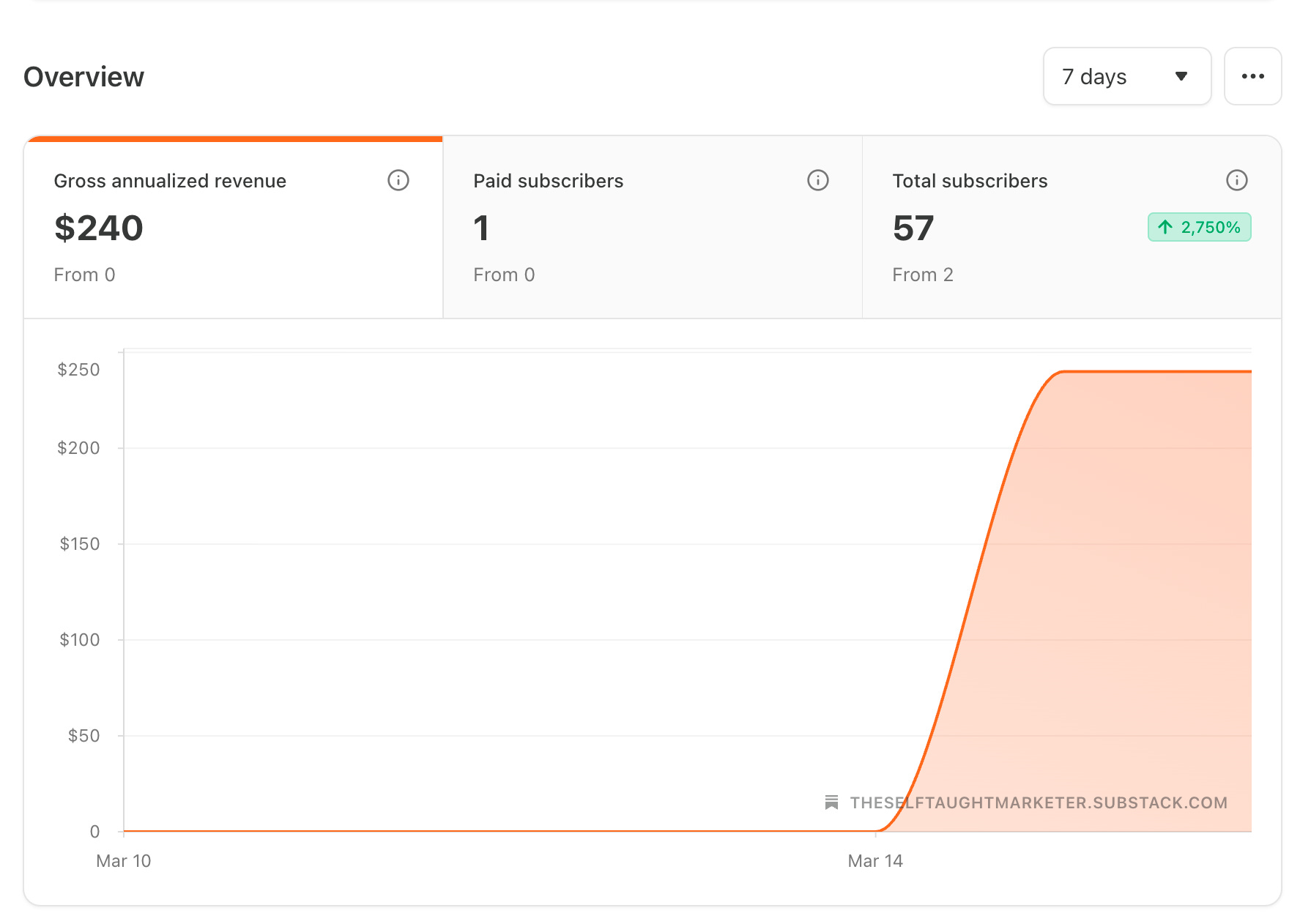
57 subscribers from 7,336 unique views means a 0.78% conversion rate.
That is a promising conversion rate given that most of my followers came for programming content, not marketing advice.
What I Learned
The experiment worked. My book’s hook is compelling enough to get people to subscribe before I’ve posted a single piece of content. That matters because a hook that doesn’t stop people from scrolling means nothing else in your marketing will either.
Now I know the hook can drive attention and convert subscribers, which gives me a channel to promote the book when it launches.
Doing this experiment was nerve-racking. At first, I thought I wouldn’t get any new subscribers. I kept refreshing, and nobody subscribed. I thought, “Oh no, I came up with a stupid book idea, I’m going to embarrass myself.”
But that is the thing. Good marketing requires discomfort and vulnerability. Most people won’t ask their best customers to get on a call and tell them what’s actually working. Or talk about a difficult subject. Or risk public embarrassment. But those things are often what makes the difference between a successful launch and nobody buying.
What Is Next
My next experiment is testing whether this same hook can convert cold paid traffic from ads. I will be running Meta ads using the opening of my book, targeted at solo builders, people marketing their own books, podcasts, apps, and products and services without a team. I’ll share exactly what I spend, who I target, what it costs me to get a new Substack subscriber, and whether the economics make sense as a long-term strategy for selling my book. If it works, I’ll have a repeatable system for acquiring subscribers and driving attention to my new book. If it doesn’t, I’ll tell you exactly why and what I’m trying next.
Subscribe if you want to see whether this experiment actually works.
And feel free to DM me with any marketing questions @coryalthoff on Instagram or learn more at coryalthoff.com
Scoreboard
The Self-Taught Marketer Copies Sold: 0
Goal: 200K+
Substack Subscribers: 57
Goal: 50,000
Your hook was aggressively hooky (and I stand by that word). A few posts in and you’re already capturing an audience like a pro! I’m following and subbing for sure! This starving artist is here to learn a thing or two (or ten)
Sincerely,
a fan ❤️
Really good read. The part about validating the audience before fully committing stood out to me. A strong hook matters, but making sure it connects with the right people matters just as much.