

I’m running and documenting marketing experiments to see if I can get my forthcoming book, The Self-Taught Marketer, to 200k+ in sales.
In my first experiment, I posted my book’s hook on social media to start building an audience of early supporters.
In this week’s experiment, I spent $157 on Facebook and Instagram ads using that same hook to see if I could acquire more early supporters, and at what cost.
The Experiment
My prior social media experiment was successful, and the results were encouraging. But I can’t just post on Instagram every week and expect to get to 200K+ in book sales.
That’s why the stakes for this experiment were terrifying: it would answer whether the world cares about my book outside of my existing warm audience.
When I was getting ready to run this experiment, I had a lot of anxiety. Publicly announcing I was going to sell 200K+ copies of my new book by running marketing experiments in public was frightening, bordering on crazy.
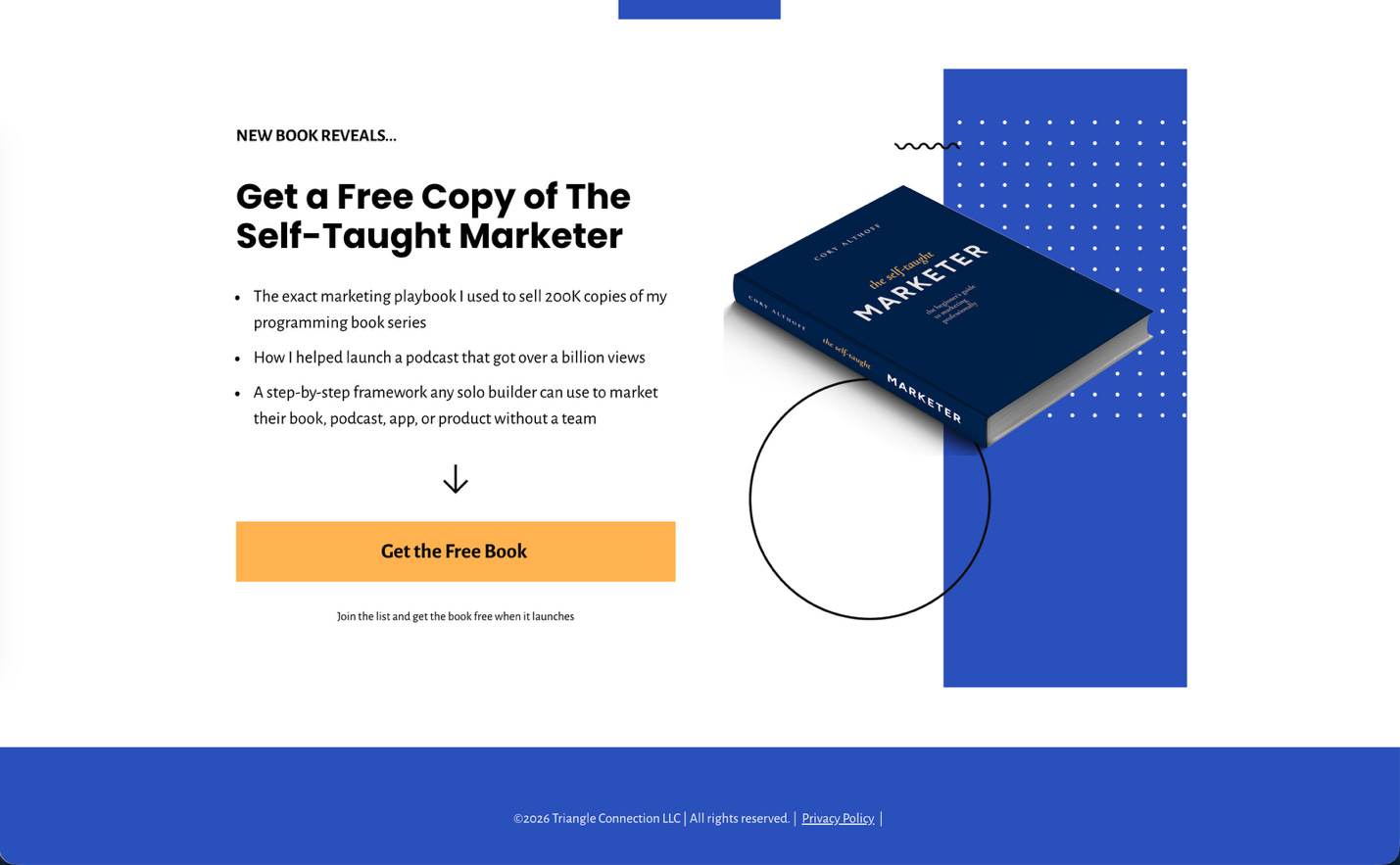
First, I created a simple website to send people to after they clicked on my ad.
I used Lead Pages to build it using one of their premade squeeze page templates.
It took me around two hours to build my squeeze page. There was no coding involved.
I decided not to invest in a fancy setup to import the email addresses into my system and instead manually add them to my Substack.
The offer I created was simple: enter your email to join my Substack and receive a digital copy of The Self-Taught Marketer for free when it’s released.
Once I created the squeeze page, I had to install my Meta Pixel to track conversions when people subscribed. That took about thirty minutes.
After I installed the Meta Pixel, I created a privacy policy. I used Termly.io to get it done quickly (maybe 10 minutes).
All that was left to do was create the ad. For the text, I used my book’s hook, followed by a call-to-action to go to read.selftaughtmarketer.com to join my Substack and get the book for free when it comes out. That took maybe 15 minutes.
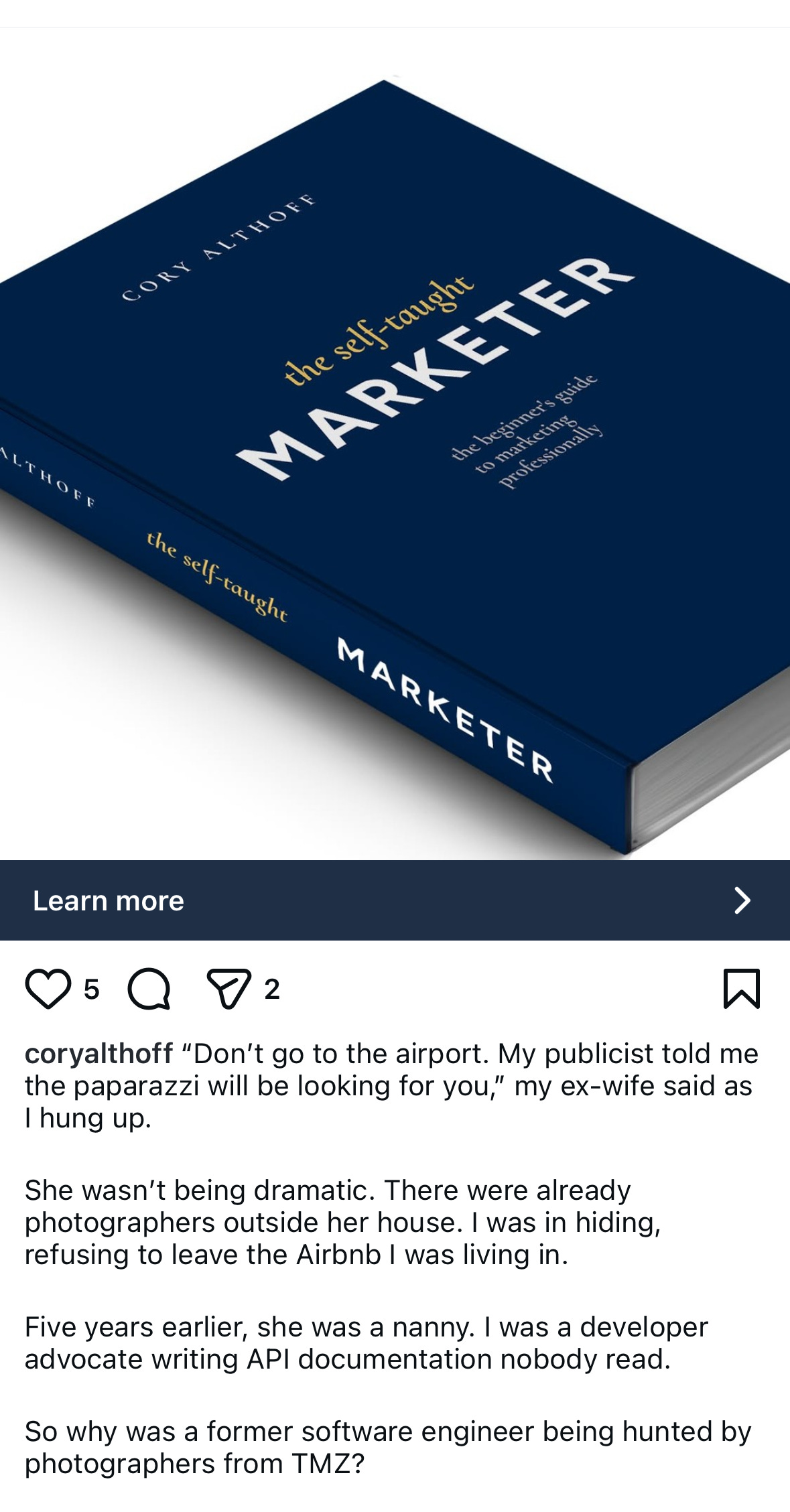
I didn’t manually target a specific audience; I let Meta optimize based on conversions. I also didn’t restrict placements (Instagram, Facebook, etc.) or test any variations. These are the results from my first try.
The Results
The first result came quickly, much faster than I expected, and at a lower cost, with my first subscriber costing me $1.77.
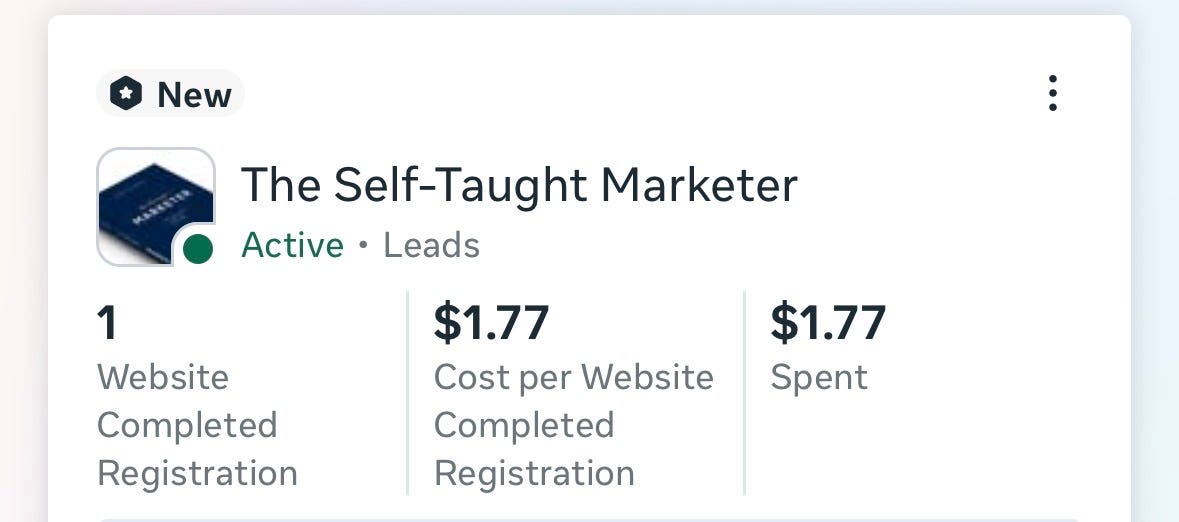
To put this in perspective, let’s look at how much it normally costs to acquire subscribers for a newsletter/Substack. Here are some benchmarks to compare that to:
$2.50 = Good,
$2 = Great,
$1.50 = Excellent
$1.00 = World class
So, you can see why I was excited about $1.77.
The last three days of the experiment, each new subscriber cost me $1.57. That’s when it hit me. This might actually work.

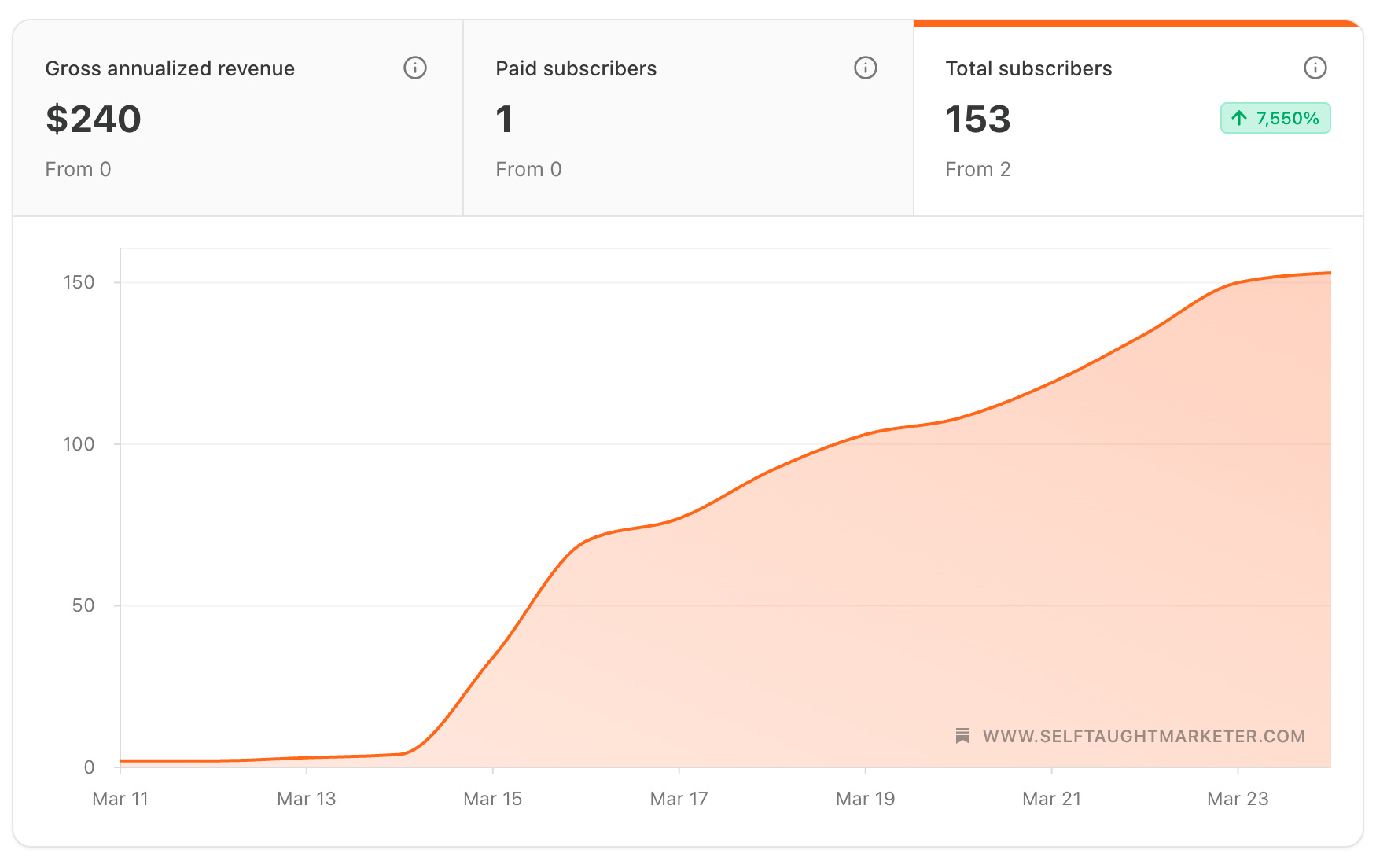
And here is my Substack growth since I ran my first experiment:
What I Learned
The main takeaway from this experiment is that the hook I used on my warm social media following also attracted new Substack subscribers from a paid cold audience. This confirms that my book’s premise resonates with people who haven’t heard of me before.
That’s what I needed to know, and it was a huge relief.
One of my weaknesses in marketing is letting my perfectionism slow me down. In the ads I ran, I used a picture of the book with a subtitle I no longer plan to use, just to move faster.
I also skipped setting up automation to auto-subscribe people to my Substack after they signed up on Lead Pages. In the past, I would have let that derail my whole experiment.
I did eventually set up a Kit automation to send a welcome email and accidentally triggered a series of premade emails about motherhood. So if you got an email with the subject 'Things no one tells you about motherhood' from me, sorry about that 🤦.
Let’s run some numbers.
At $1.57 per subscriber, it would cost me $7,850 to gain 5,000 subscribers.
Many Substacks convert 1% to 5% of their free subscribers to paid subscribers. My paid tier is $8 a month (I have not worked on promoting paid much yet).
Let’s assume I can hit a 3% free-to-paid conversion rate. At 5,000 free subscribers, my list would generate roughly $1,200 a month.
But my Substack isn’t my only potential revenue stream. I’m sending a free digital copy of The Self-Taught Marketer to everyone who subscribes when it’s available.
Even if only 10% of those 5,000 subscribers also buy a paperback because they also want a physical copy, want to support the project, or want to give it as a gift, that’s 500 paperback sales at launch. At $7 profit a copy, that’s an extra $3,000.
That means I would break even on the ads within the first year.
Ad spend builds the list, the list buys the book, and book revenue funds more ads.
That’s my hypothesis. My next few experiments will tell me whether it is correct.
What is Next
For my next experiment, I will try to get 1,000 subscribers for $1,000 or less.
I am already at $1.57, which is excellent. But if I can get to sub-$1, my entire model becomes much more powerful because, under my current assumptions, it would take up to a year to break even on my ads.
The faster I break even, the more ads I can run. And the more ads I can run, the faster this whole thing could scale.
If I can’t lower my cost per subscriber, I will have to rely more on free-acquisition channels like viral marketing and cold outreach to hit my sales goals, which will be more difficult and may not work. Next week we find out.
Scoreboard
The Self-Taught Marketer Copies Sold (not out yet): 0
Sales Goal: 200K+
Substack Subscribers after my last experiment: 57
Substack subscribers this week: 153 (+96 since last experiment)
Substack Goal (pre-book launch): 5,000
Substack Goal (post-book launch): 50,000
If you enjoyed this post, please hit the like button. It helps more people discover my experiments.
Learn more at coryalthoff.com
“One of my weaknesses in marketing is letting my perfectionism slow me down.”- this sentence right here is a problem for so many people!
I love this experiment, and the break down you explained along with the programs you used and time it took you to do it! I absolutely love marketing, and think so many people don’t understand it and are scared of it!
Amazing article!! 🤍
Hi cory i dont subscribe to you but i constantly see your posts in my feed. I am very much in the process of figuring this substack app out. By the way i dont mind seeing your posts but am perplexed as to why i am not interested in marketing but i have been pushing my stack. I wonder if subscribe to your stack will i see less posts not that i am bothered either way just trying to work out the system. Haha