

If you want more posts like this, where I break down what actually works in marketing and why (numbers and all), subscribe below.
Time was running out.
I had seven days left to get 1,000 new leads for my business by spending $1,000 or less on Facebook and Instagram ads.
That’s the challenge I had publicly set for myself, and if I was going to hit it, I needed images for my ads.
“I literally do not understand why you get the text wrong every single time,” I typed to ChatGPT after the 20th time it got the image I told it to make for my ad wrong.
I don’t have design skills.
And I didn’t have time to learn.
But ChatGPT kept telling me to do it in Canva.
“I DON’T KNOW HOW TO USE CANVA.”
Forget it.
I decided to test images with just a little bit of AI gibberish where there was supposed to be normal text.
It was close enough.
The Experiment
To get 1,000 new leads for my business for $1,000 or less by running Facebook and Instagram ads, I needed to spend $1 or less per new potential customer.
For the record, the average cost for a new lead on Instagram and Facebook is around $27.66.
Fortunately, I wasn’t starting from scratch.
In last week’s experiment, I wrote an ad that generated new leads for $1.57.
So I only needed to shave 57 cents per lead off the ad I was already running to hit my goal.
The ad I created last week tells the story of my ex-wife telling me not to go to the airport because the paparazzi would be looking for me.
Once I got their attention, I offered my book for free in exchange for their email address.
That’s called a lead magnet.
The idea is simple: give something valuable first, earn their trust, then sell them something later.
But before you earn their trust, you need to get their attention.
Good ads on social media are all about making someone stop scrolling by capturing their attention with something interesting.
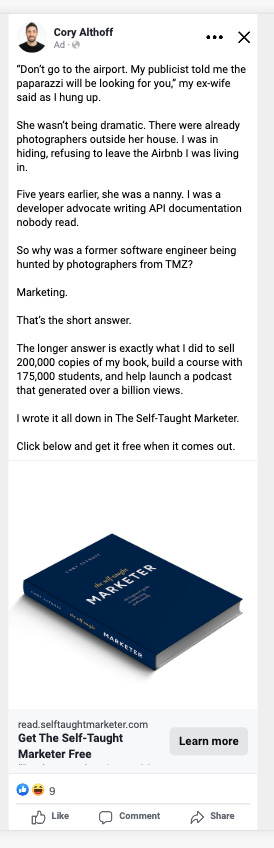
My ad from last week did that by telling my paparazzi story.
But you don’t need a story as dramatic as mine to write a good ad: you just have to tell an interesting story instead of saying something generic about your business.
I will dive deeper into writing ads that convert in my upcoming experiments.
But for now, back to trying to get new customers.
I already had an ad.
I just needed to make it better.
To hit my goal, I decided to test new images, text, and any other changes I could think of to my ad to shave off those 57 cents.
If you are a self-taught marketer like me (the person responsible for marketing a product or service without a marketing team), and you haven’t tried running ads yet, you should consider giving it a try.
You can start with an ad that offers a lead magnet like I’m doing here.
A coach can offer a free consultation.
A contractor can offer a free estimate or a home inspection checklist.
A store owner can offer a discount or a free sample.
Consultants can offer a free chapter, a digital copy of their book, or a guide to solving a problem their clients commonly face.
Whatever you’re selling, leading with value before asking for money is almost always the right move.
The Results
On the first day of the experiment, I tested new images, text, and targeted different audiences to lower my cost per lead.
In the ad I created last week, I did not do any targeting.
That means I did not tell Meta (the company that owns Instagram and Facebook) which customers would be interested in my offer.
For example, I could have told Meta to only show my ad to people in California who are interested in entrepreneurship.
Instead, I allowed Meta’s magic algorithm to figure it out.
However, sometimes you can get better results by targeting, sometimes you can’t.
That is why testing is important.
So I tried targeting people interested in books, self-improvement, and entrepreneurship.
The result? My cost per lead went from $1.56 to $5.
Not good.
It turns out Meta’s algorithm is pretty good at what it does.
Next, I tried using the same text from the original ad with new images (without any targeting).
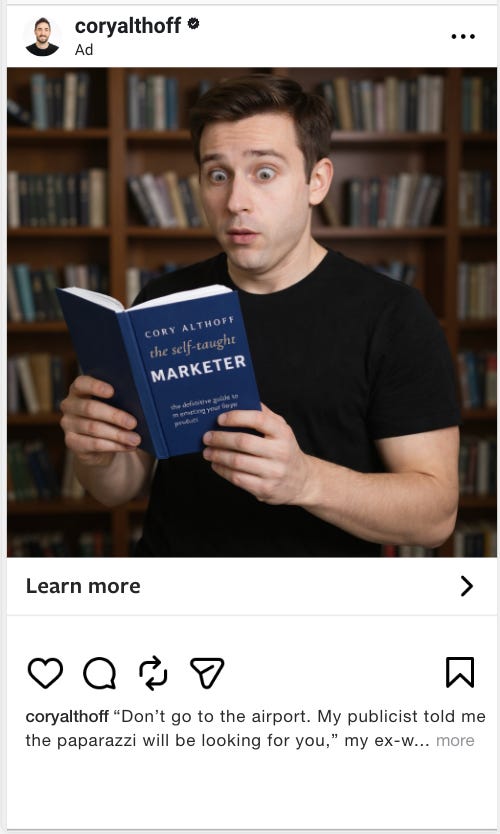
No luck there either.
Day two I knew I needed to try something completely different, so I decided to use the same premise as my high-performing ad but tell the story in video form.
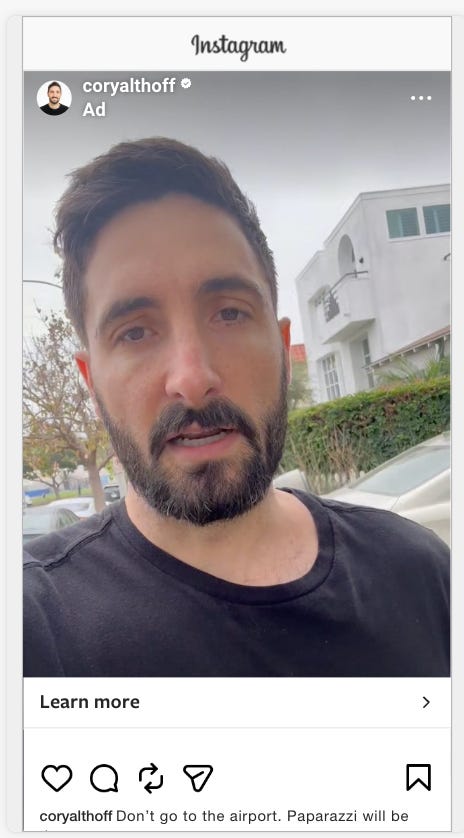
I tried multiple variations of the video ad.
They performed a little bit better than the previous tests, but not by much.
I went back to trying even more new pictures in my ads.
I tried shortening the story in the original ad.
But nothing helped lower my cost per lead.
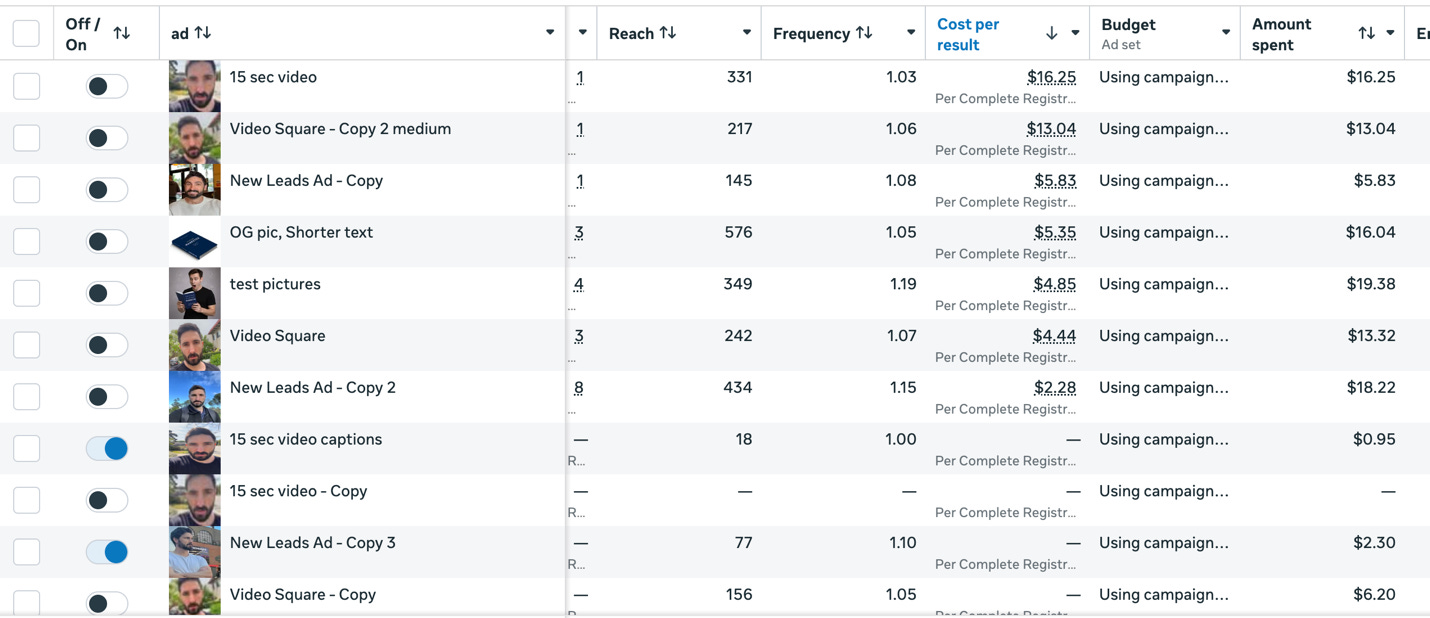
I started digging into the data to understand what was happening.
Last week’s ad was costing me around a dollar per website visit, but converting at 40% — meaning 4 out of every 10 visitors were signing up to get my book.
That’s incredibly high.
The reason: the book image filtered for intent.
Only people who actually wanted a free book clicked.
The video ad got cheaper clicks, but those people were just curious. They weren’t signing up.
That’s when it dawned on me: I couldn’t lower the cost per click to my website without also tanking my conversion rate.
$1.55 was my floor.
What I Learned
Even though I was unable to beat my previous ad with this experiment, I still learned a few useful things.
I now have a benchmark cost per lead to compare against all the other marketing channels I will test in upcoming experiments.
For example, I plan to pay influencers to post the same ad I ran on Meta. Now I have a number to beat.
This experiment was also a great reminder that curious clicks don’t drive real results.
When you create ads, clicks are worth nothing unless your ad attracts the right potential customers for your business.
That means engagement for the sake of engagement is a waste of time.
You need to engage people and filter for intent at the same time.
The simplest way to do that is to make your ad so specific about what you're offering that only the right people bother to click.
Furthermore, this experiment shows that sometimes spending a lot of time on optimization is not worth it.
I had an idea for an ad, wrote the hook, and the first version worked better than any others I tried.
Optimizing it further did not get me better results.
Sometimes, you need to be happy with your results and move on to other areas where you can improve your marketing.
What’s Next
This week, I was unable to get 1,000 leads for $1,000 by lowering the cost per click on my ads.
That does not mean I am giving up on my quest to get 1,000 leads for $1,000.
Next week, I’m shifting focus to the other side of the equation: the website where people are giving me their email address.
If Meta’s algorithm won’t give me cheaper traffic, I will have to make the traffic I already have convert better.
I’m running an experiment on read.selftaughtmarketer.com (the webpage I’m sending people from my ads to) to find out if I can get more people to sign up for less.
I’ll also dive deeper into the system I’m building to generate new leads and turn them into customers, so you can see how everything works and how I plan to make money from those leads.
As always, I will be sharing real numbers and real results.
Scoreboard
The Self-Taught Marketer Copies Sold (not out yet): 0
Sales Goal: 200K+
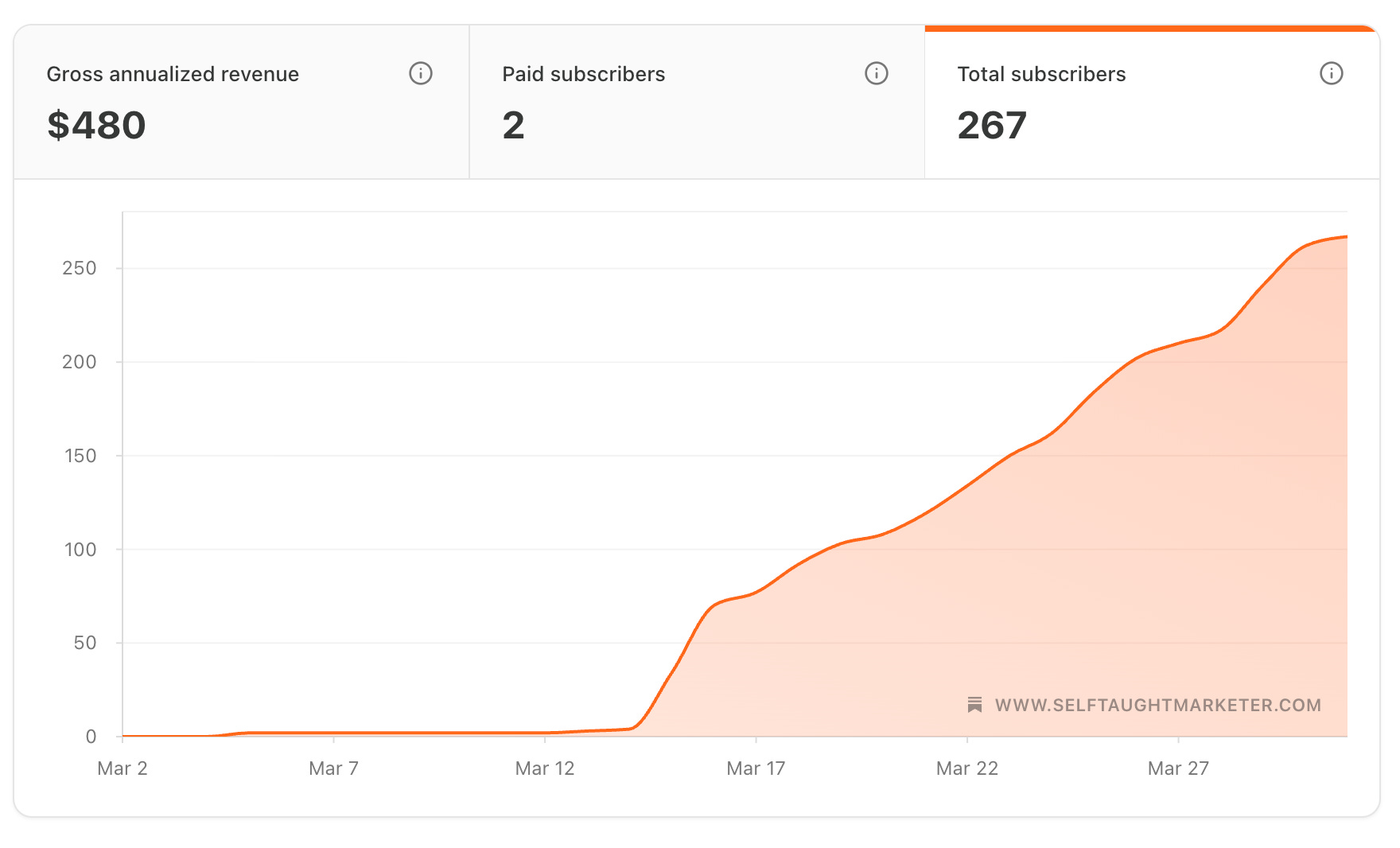
Substack Subscribers after my last experiment: 153
Substack subscribers this week: 267 (+114 since last experiment)
Substack Goal (pre-book launch): 5,000
Substack Goal (post-book launch): 50,000
Consulting Revenue (coming soon): 0
Learn more at coryalthoff.com.
This is excellent, Cory, spot on! Of your first three, this is my favorite because it's so easy to understand. 👏🏻👏🏻👏🏻🤩🤗🥳